
Most memory games are designed to be won by four-year-olds. Bright, cartoonish icons, deliberately distinct, matched in a few turns. That is entirely appropriate for the audience — but it does mean the format is usually abandoned the moment a household’s youngest child outgrows it.
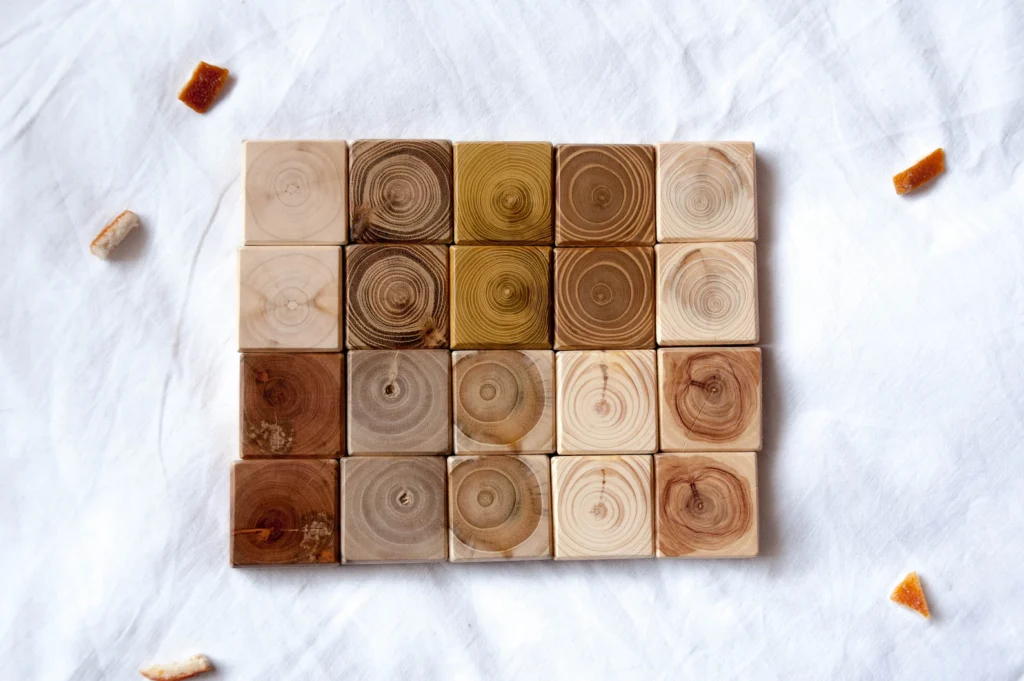
The Wood Grain Memory Game takes a different approach. Instead of illustrations, the faces are tree-ring grain patterns — and that single decision changes both how the game plays and where it lives in the house.
Why Grain Patterns Change the Game
Matching a duck to a duck is a recall task. Matching one growth-ring pattern to its twin is a genuine visual discrimination task. The differences between tiles are real but subtle — ring spacing, the drift of the heartwood, a knot slightly off-centre — so players have to look properly rather than glance.
The practical effect is that adults find it engaging rather than tedious, and the difficulty scales naturally with attention rather than age. It is one of the few memory games that works as well between two adults as it does with a child.
An Object That Can Stay Out
The second advantage is aesthetic, and it matters more than it sounds. Most children’s games are visually loud enough that they get shut in a cupboard between uses. A set of wooden tiles in natural tones can sit on a coffee table or a shelf without apology.
Games that stay visible get played. Games that live in a cupboard do not. For a household trying to reduce screen time, that is a more meaningful design consideration than it first appears.
What to Confirm Before Ordering
Handmade wooden games vary considerably between makers, so it is worth reading the listing details closely:
- Tile count and diameter. These determine both difficulty and how much table the game needs.
- Finish. Confirm the sealant or oil is non-toxic and child-safe if younger players are involved.
- Printed or genuine grain. Some makers print patterns onto blanks; others use real cross-sections. Both work, but they age very differently.
- Storage. A bag or box is worth having — loose tiles migrate.
- Age suitability. Small wooden discs are a choking hazard for the youngest children, so check the maker’s stated minimum age.
The Verdict
This is a considered reworking of a familiar format rather than a novelty. It suits households that value tactile, screen-free play, and it makes a strong gift for anyone drawn to natural materials or Montessori-style toys — a category where genuinely well-designed objects are harder to find than the market would suggest.