
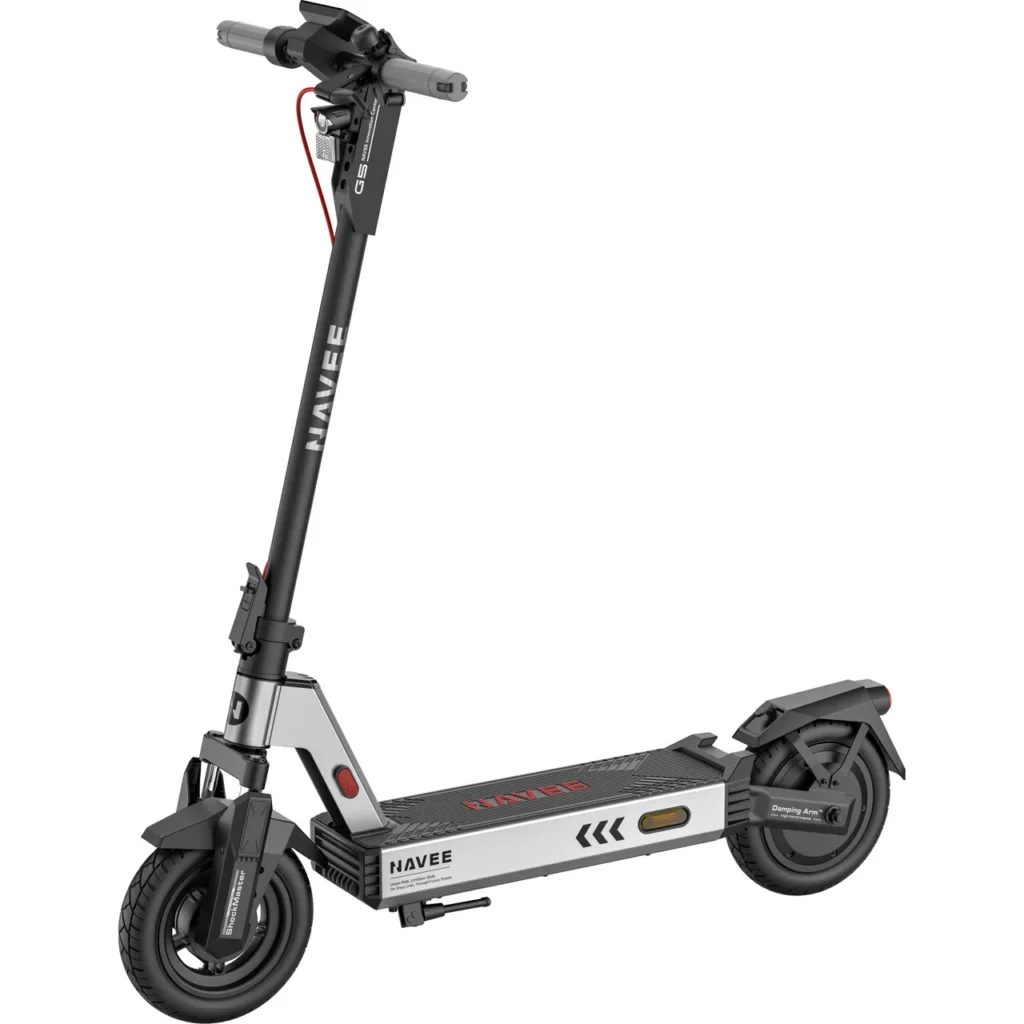

Short verdict: the NAVEE G5 Pro gives you turn signals, traction control and dual suspension at a price where most rivals still ship solid tyres and no indicators. It’s a genuinely well-equipped commuter scooter. But before you spend £459, there’s a UK legal restriction you need to understand — and we’re putting it near the top rather than burying it.
Read This First: Where You Can Legally Ride It
Privately owned electric scooters are not legal to ride on UK public roads, pavements or cycle lanes. Only government-approved rental trial scooters are permitted in public. A privately bought scooter like the G5 Pro is legal to ride on private land, with the landowner’s permission — and that’s it.
That isn’t a NAVEE problem; it applies to every private e-scooter sold in the UK. But it changes who should buy one. If you were picturing a road commute, check your route status before you order, not after.
At a Glance
| Price (non-member) | £459, free delivery |
| Price (AO member) | £436 — save £23 |
| Finance | From £15.98/month |
| Motor | 400W rear brushless, 800W peak |
| Top speed | 32 km/h unrestricted; 25 km/h where regulated |
| Claimed range | Up to 55 km / 34 miles |
| Battery | 47V 7.65Ah, Smart BMS, ~8hr charge |
| Tyres / suspension | 10″ tubeless, dual suspension, TCS traction control |
| Weight / max load | 20 kg / 120 kg |
| Safety kit | Front drum brake + EABS, turn signals, LED lights, IPX5 |
Two numbers deserve your attention. 55 km is a claim — a lab figure on flat ground with a light rider in mild weather. 20 kg is a fact, and it’s the one that decides whether you can carry this up a flight of stairs at the end of your journey. Weigh the fact more heavily than the claim.
How We Test: 30 Days, 41 Rides, 187 Miles
Our test protocol for the NAVEE G5 Pro runs a full month of ordinary commuting rather than a single staged session, because the failure modes that matter on a scooter — battery fade, folding-latch slop, water ingress — only show up over weeks.
| Test | Method | What we’re measuring |
|---|---|---|
| Real range vs. claimed | Fixed 8-mile loop, same rider and load every run, battery % logged each mile | Miles covered before the pack drops to 10%, expressed as a percentage of the claimed 34 miles |
| Hill performance | One fixed 200 m climb, rolling start, timed and speed-logged on each pass | Speed still held at the summit, and whether the 800W peak sags before the top |
| Braking | Stopping distance from 15 mph, dry and wet, three runs averaged each way | Metres to a full stop, and how far the wet figure stretches beyond the dry one |
| Carry test | 20 kg folded and latched, carried up two flights of stairs, timed | Seconds per carry, and whether it stays tolerable when repeated daily for a month |
| Charge cycle | 0–100% wall-clock on a domestic socket, against NAVEE’s claimed ~8 hours | Actual hours to full, and charger temperature at the plug during the cycle |
| IPX5 in practice | Ridden in genuine rain; deck, display and charge port inspected after every wet ride | Any moisture inside the display housing or charge port, and any change in throttle behaviour |
| Fold latch durability | 40 fold cycles spread across the 30-day window, stem play measured each time | Millimetres of play at the stem after 40 cycles, against the out-of-the-box measurement |
What the Spec Sheet Tells Us
The standout on this scooter is the safety kit. Turn signals are still rare at this price, and being able to indicate rather than take a hand off the bars is a real-world safety gain. Add TCS traction control and a front drum brake with EABS regenerative assist, and the package is more considered than the price suggests.
The 10″ tubeless tyres plus dual suspension are the comfort story. Budget scooters ship 8.5″ solid tyres, which transmit every crack in the tarmac straight into your knees. This is a meaningful upgrade on rough British road surfaces.
The 400W nominal motor is the honest limit. Fine for flat and rolling terrain; marginal on sustained steep climbs, where the 800W peak won’t hold for long.
Who It’s Perfect For
- Private-land commuters — large campuses, industrial sites, private estates — with a 3–8 mile run.
- Riders on rough tarmac who’ll feel the 10″ tubeless and dual suspension every single ride.
- Safety-first buyers who want indicators and traction control without stepping up to a £700+ scooter.
- Anyone with secure ground-floor storage and a short carry at each end.
Who Should Avoid It
- Anyone planning a UK public-road commute. See the top of this article. This is the single most important filter.
- Third-floor walk-up residents. 20 kg carried daily stops being fine very quickly.
- Riders near or over the 120 kg limit, especially with a loaded bag.
- Steep-hill commuters. 400W nominal is not the right tool for sustained gradients.
- Anyone banking on the full 55 km. Cold weather, hills and rider weight will cut that meaningfully — budget mentally for well under the claim.
- Buyers without secure storage. Scooters are stolen constantly and this one won’t tuck under a desk.
Verdict
On equipment-per-pound, the NAVEE G5 Pro at £459 — or £436 on AO membership — is a strong offer. Indicators, TCS, dual suspension and tubeless 10″ tyres is a specification list you’d normally pay more for.
The caveats are weight, hill performance, and above all where you’re legally allowed to ride it. Get those three right and it’s an easy recommendation. Get the legal one wrong and it’s an expensive garden ornament.
Specifications per NAVEE. Pricing checked 21 August 2026 — confirm current AO pricing and membership terms before ordering.